
Psychometric Test for Career Guidance: Discover Strengths and Plan Your Future
Why Choosing a Career Can Be Difficult
Picture a Class 10 student who enjoys mathematics, loves drawing, and is curious about computers. With so many interests, deciding on the right stream or career can feel overwhelming. Many students rely on marks, peer influence, or family expectations, but these factors alone may not lead to fulfilling choices.
Psychometric testing offers a structured way to understand personal strengths, interests, and aptitudes—helping students make better-informed decisions about their future.
What Is a Psychometric Test?
Psychometric tests are structured assessments designed to measure psychological characteristics relevant to education and careers.
- Aptitude tests: Measure abilities like numerical, verbal, spatial, or logical reasoning.
- Personality assessments: Explore behavioural patterns, preferences, and interaction styles.
- Interest inventories: Identify subjects, activities, and occupational areas that appeal to a student.
- Skills assessments: Evaluate existing competencies.
- Values and motivation assessments: Highlight preferences for work environments, independence, or security.
⚠️ Not every online quiz qualifies as a psychometric test. Reliable assessments are evidence-based and professionally designed.
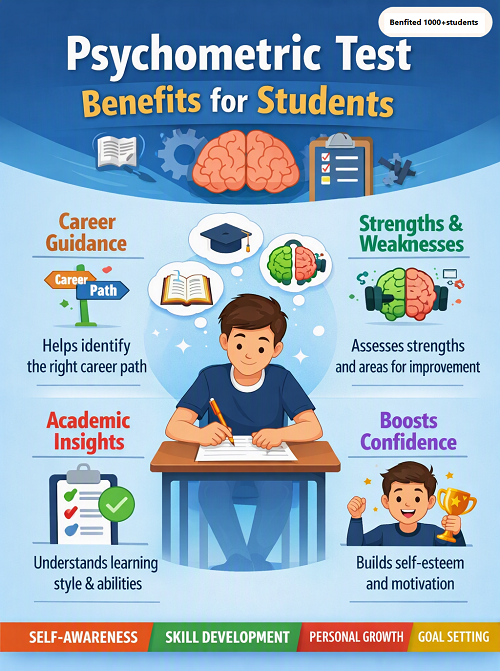
Why Should Students Take a Career Assessment?
Psychometric tests help students:
- Gain self-awareness.
- Understand interests and preferences.
- Identify areas for skill development.
- Compare career alternatives systematically.
- Have better conversations with parents, teachers, and counsellors.
Limitations exist: results depend on test quality, administration, and interpretation. A test is a guide, not a guarantee.
How Does a Psychometric Test Work?
- Identify the student’s stage and career questions.
- Select an appropriate, validated assessment.
- Complete the test as instructed.
- Review results and explanations.
- Discuss findings with a career counsellor.
- Compare results with academic performance and goals.
- Research career options before deciding.
Some tests are self-administered, while others require professional interpretation. Duration and format vary.
How to Interpret Psychometric Test Results
Students should look at:
- Strengths and development areas.
- Interest patterns and occupational environments.
- Aptitude scores relevant to activities.
- Personality preferences without rigid labels.
- Inconsistencies across results.
Lower scores don’t mean exclusion from a career—skills can be developed, and interests evolve.
Convert Test Results into a Personalized Career Roadmap
Stage 1 — Self-discovery
Identify interests, strengths, values, and learning preferences.
Stage 2 — Career exploration
Research 3–5 career paths aligned with results.
Stage 3 — Educational planning
Choose suitable streams, degrees, vocational courses, or certifications.
Stage 4 — Skill development
Focus on technical and transferable skills like communication, problem-solving, and digital literacy.
Stage 5 — Practical exposure
Seek internships, projects, volunteering, competitions, or job shadowing.
Stage 6 — Goal setting
Set measurable short-, medium-, and long-term goals.
Stage 7 — Progress review
Update the roadmap as interests and circumstances change.
Example: A student strong in mathematics and technology might explore data analytics, software development, or actuarial science before selecting a course.
How to Choose a Reliable Psychometric Test
Look for:
- Evidence of reliability and validity.
- Age-appropriate design.
- Cultural and linguistic suitability.
- Clear explanations of what is measured.
- Transparent fees and limitations.
- Professional interpretation when needed.
Frequently Asked Questions
- What is a psychometric test for career guidance? It’s a structured assessment that measures aptitudes, interests, personality, or skills to support career decisions.
- Are psychometric tests useful for Class 10 students? Yes, they help students choose streams and subjects aligned with their strengths and interests.
- Can a psychometric test guarantee my career success? No. It’s a guide, not a prediction. Success depends on effort, performance, and opportunities.
- How do I know if a test is reliable? Check if it’s evidence-based, age-appropriate, and preferably administered by a qualified counsellor.
- Should parents be involved in interpreting results? Yes, constructive discussions with parents and counsellors help students make balanced decisions.